In mid-October, in the capital city of Thimphu, the secluded Kingdom of Bhutan, a country built on the philosophy of Gross National Happiness, took a radical digital step. It began migrating the credentials of its roughly 800,000 citizens onto the Ethereum blockchain, establishing a pioneering framework for decentralized identity that stands in stark contrast to the centralized ID systems rising across the West. Bhutan has now officially anchored its National Digital Identity system on Ethereum, the first nation to do so on a public blockchain.
In Brief
Bhutan’s migration to Ethereum marks the latest expansion of its “Digital Drukyul” initiative, a long-term modernization project aimed at building a transparent and secure digital state. The National Digital Identity (NDI) system, first developed on Hyperledger Indy before moving to Polygon in August 2024, now operates on Ethereum. This marks the first time a nation has adopted a public blockchain for identity verification at national scale.
At a ceremony in Thimphu on October 14, 2025, attended by King Jigme Khesar Namgyel Wangchuck, Prime Minister Tshering Tobgay, and Ethereum co-founder Vitalik Buterin, the Kingdom officially migrated its National Digital Identity (NDI) system onto the Ethereum mainnet.
Prime Minister Tobgay described the launch as “a new milestone in becoming a leader in digital governance,” saying the goal is to create an “interoperable, user-owned identity system” aligned with “the King’s vision for a safe, inclusive, and digitally empowered society.”
Ethereum Foundation President Aya Miyaguchi called the shift “a global step toward a more open and secure digital future,” noting that Bhutan’s integration was now fully operational.
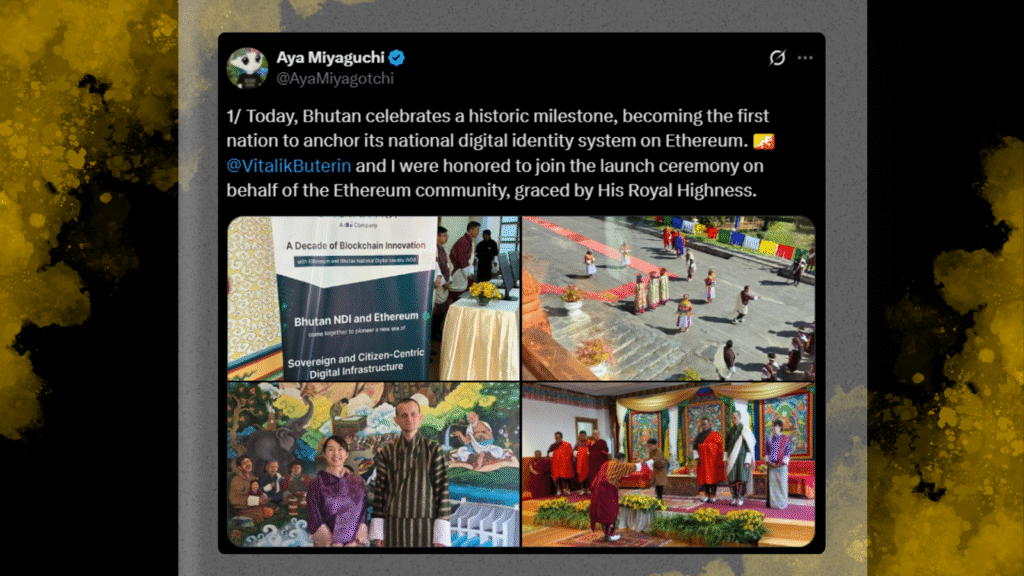
Under the new framework, Bhutanese citizens mаnage their credentials through secure mobile wallets. These wallets allow them to prоve their identity for services such as passports and driver’s licenses. Unlike traditional systems, users share only the information required for verification, using zero-knowledge proofs—cryptographic methods that allow selective data disclosure.
Buterin, who attended the launch, said, “Decentralized digital identity empowers people by giving them more secure control over their data and their online lives.” He added that Bhutan’s “embrace of an open architecture on Ethereum” reflects the blockchain’s founding ideals of open-source innovation and transparency.
The migration was driven by the government’s GovTech Agency, led by Secretary Jigme Tenzing, who said the country was “continuing to strengthen” its digital identity framework by leveraging Ethereum’s security and global developer infrastructure.
Related: Programmable Receipt: Ultimate Guide to Navigating the SOU NFTs
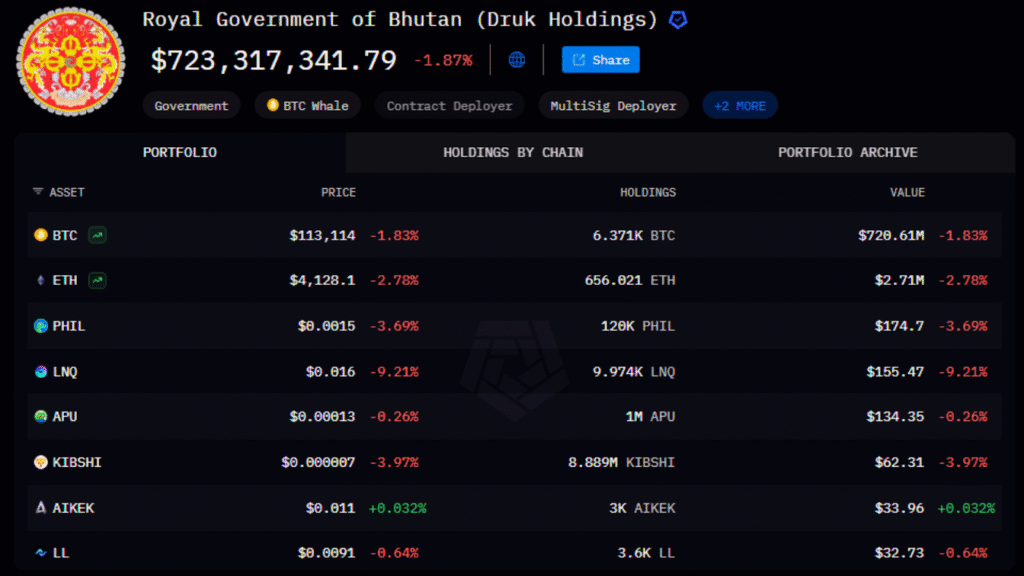
Bhutan’s blockchain ambitions extend beyond identification. The country holds an estimated 11,286 Bitcoin, worth roughly $1.31 billion as of October 14, 2025, mined through renewable hydropower, according to on-chain data. Bhutan has also explоred Ethereum and other crypto assets as potential sovereign reserves.
The government’s ongoing investments reveal a broader strategy. Bhutan is positioning itself as both a participant in and a test case for blockchain-based public infrastructure.
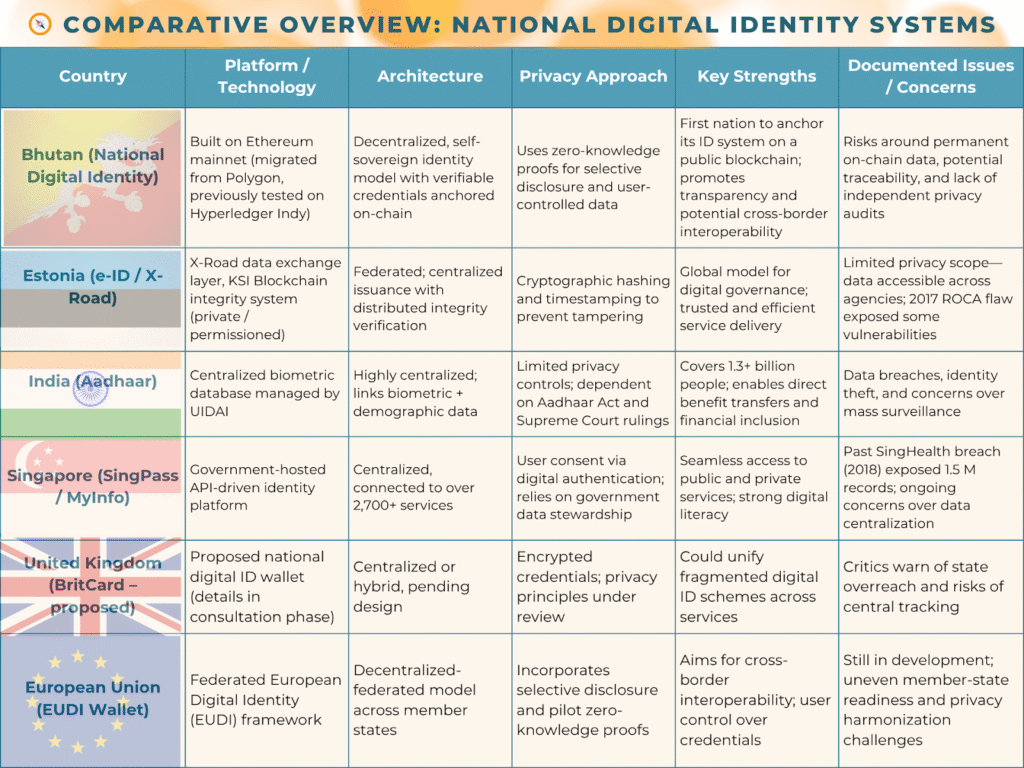
While Bhutan moves citizen data to a decentralized blockchain, most countries still use centralized databases.
Estonia’s e-ID, launched in 2002, remains centralized despite using public key infrastructure. It suffered breaches such as the 2017 ROCA flaw and a 2021 photo leak.
India’s Aadhaar, serving 1.3 billion citizens, operates under a single national database and has been criticized by civil libertarians as enabling mass surveillance. Singapore’s SingPass app, though secure, was affected by the 2018 SingHealth breach that еxposed 1.5 million records.
The UK’s proposed BritCard, an encrypted smartphone wallet for work and residency checks, has drawn privacy concerns that it could “shift the balance of power toward the state.”
Bhutan’s Ethereum-based identity system, by contrast, distributes data across a public ledger, reducing single points of failure and enabling self-sovereign data control. It remains the only verified national system of its scale operating on a public blockchain.
Related: 2025: The Year of the Industrialized Heist
While support has been widespread, not all experts are without caution. Kirill Avery, CEO of Alien Network, called Bhutan’s approach “a double-edged sword,” noting that “transparenсy is good for auditability, but not for privacy.”
Avery warned that on a public chain, “once credentials live on-chain, they live forever, and that permanence can quickly turn into surveillance if not handled with extreme care.”
No independent watchdog or privacy organization has yet issued a formal critique of Bhutan’s implementation. Still, Avery’s comments highlight a recurring challenge in blockchain gоvernance: maintaining verifiability without exposing personal data.
The full migration of credentials to Ethereum is expected by the first quarter of 2026. Officials have not disclosed total implementation costs or international partnerships beyond the Ethereum Foundation’s involvement.
As of mid-October, no technical issues or breaches have been reported. Globally, policymakers are watching.
As the United Kingdom, European Union, and India advance their own national ID reforms, all centralized, Bhutan’s model represents an alternative: decentralization at the state level.
Whether the Himalayan kingdom’s experiment becomеs a template for others will depend on whether privacy and trust can coexist on an immutable public ledger.
Bhutan’s choice to place its citizens’ identities on Ethereum transforms the small Himalayan nation into a global case study in digital sovereignty, a reminder that even the world’s smallest states can redefine the frontiers of governance when technology and trust align.

Yona brings a decade of experience covering gaming, tech, and blockchain news. As one of the few women in crypto journalism, her mission is to demystify complex technical subjects for a wider audience. Her work blends professional insight with engaging narratives, aiming to educate and entertain.
You cannot copy content of this page








 Follow on X
 Follow on Instagram