
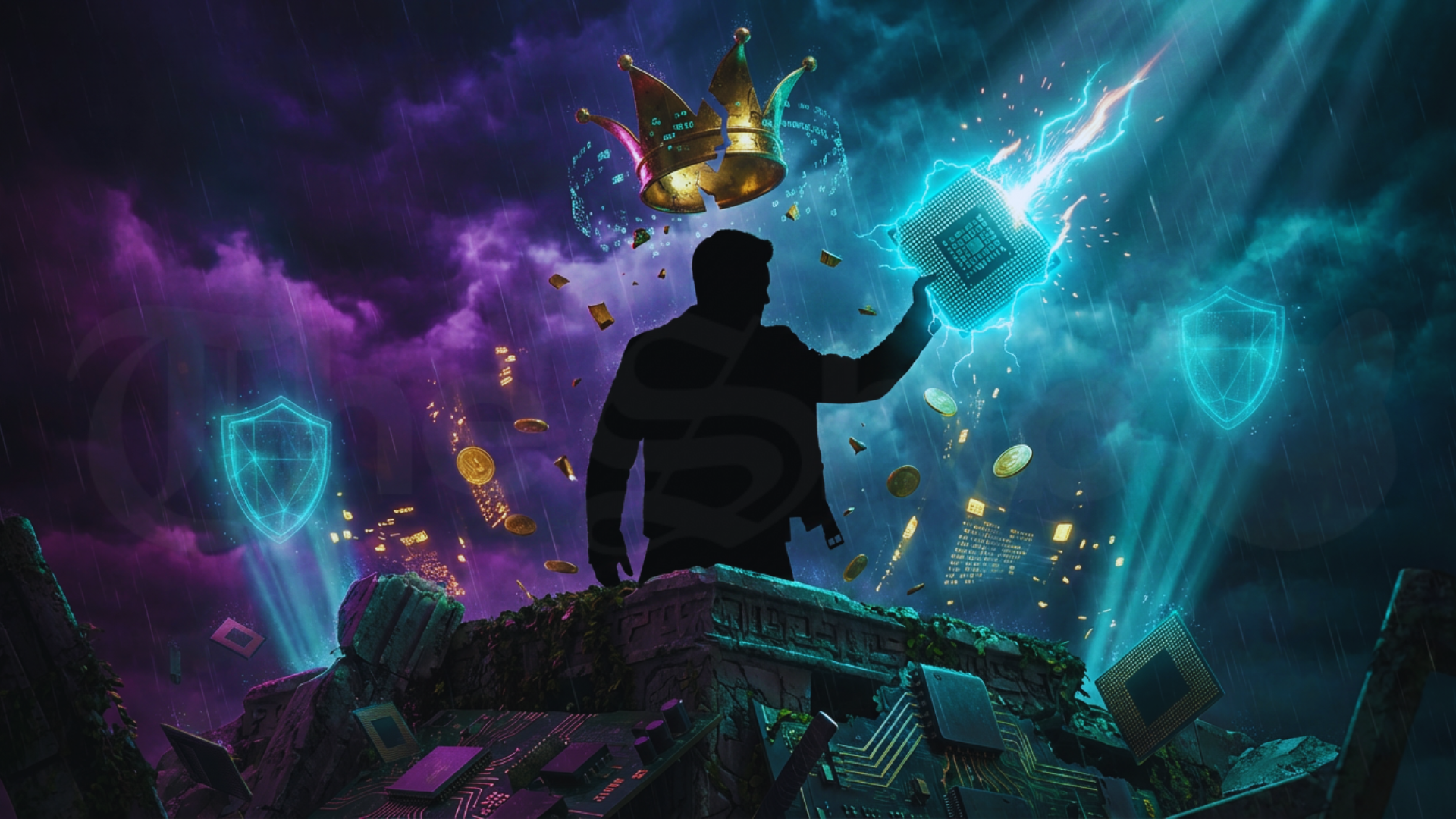
EDITOR’s NOTE: Curtains rise with a quiet, reverent gravity. PROFILES is the inaugural column for The Shib, the first stitch in an enduring tapestry woven for the collective soul of the pack. PRоFILES serves as a study in the metamorphosis of the human spirit: the remarkable journey of how common clay is sculpted into the stuff of legends and how the fleeting breath of the ordinary is exhaled as the oxygen of immortality. We invite you to experience this record, to witness the weight of the work, and to understand the architecture of the build.
In 2026, a man in a black leather jacket stands quietly on stage while the world throws trillions at his feet. He speaks softly, almost gently. But behind those calm eyes is a conqueror who survived reform school, saw multiple company deaths and lived decades of doubt and still came out on top.
This is his story.
He was nine years old when his parents bet on their future, sold nearly everything they owned and put him on a plane from Taiwan to America. They believed they were sending him and his brother to a prestigious boarding school. But, as faith has it, they landed at Oneida Baptist Institute, a reform school for troubled boys in rural Kentucky.
The first job they gave the small Asian boy was scrubbing toilets. It became his routine every single day. He got bullied mercilessly. The boy stood as the undersized kid with a heavy accent.
One night, he made a deal with his 17-year-old roommate, he offered to teach him to read in exchange that he’d be taught how to bench press. He started lifting weights. The bullying stopped.
At nine years old, he learned a lesson that would define his life: pain is just raw matеrial for power.
At 16, he graduated high school and made himself a nationally ranked table tennis player featured in Sports Illustrated. He earned degrees from Oregon State and Stanford.
He hustled. He adapted. Graveyard shifts at Denny’s provided his only income. Already a husband аnd young father, by 1993, at age 30, he sat in a Denny’s with two friends and decided to start a company with $40,000.
A napkin sketch at that same restaurant served as the first blueprint for his eventual destiny. Their mission involved building 3D graphics chips to revolutionize PC gaming.
Pain forged winners in this environment. Weakness invited destruction. He filed the suffering away as fuel.
They called it Nvidia.
Little did they know, the next decade became pure war. The first chip (NV1) flopped hard. They bet on forward texture mapping, but the industry standardized on triangles. Sales tanked. Payroll faltered. The company hemorrhaged cash by 1996, sitting six months from bankruptcy.
He laid off over half the staff. The headcount dropped from over 100 to under 40. A recurring motto dominated every meeting: “Our company sits thirty days from going out of business.” He maintained that standard for over three decades.
The Sega deal became a gut punch. Their console chip became obsolete before it shipped. He flew to Japan and begged for the final payment to cover payroll. Sega’s eхecutives сonverted the contract into a $5 million equity stake. One month of runway remained.
The RIVA 128 arrived in 1997. One million units sold in four months. The firm survived. Scars remained permanent. He ran the operation with constant anxiety, seven-day weeks, and zero vacations. Fear functioned as the engine.
Silicon Valley chased the next consumer gadget at the time,that was the trend. But, hе saw a much darker and more powerful future. He watched the early sparks of deep learning and made a decision that looked reckless for years: he bet the entire future of Nvidia on artificial intelligence (AI).
Founders usually fold after a collapse. He treated crises like rounds in a title bout. The GPUs dominated gaming by 2006, but he identified a new battlefield: general-purpose computing. He greenlit CUDA, a software platform to turn graphics cards into parallel-processing beasts for science. Wall Street ignored the move. Stock value cratered from $12 billion to $2 billion. He doubled the chip price for software nobody asked for. Silence followed.

A University of Toronto researcher crushed the ImageNet AI competition using the hardwаre in 2012. Neural networks suddenly scaled. He ripped the corporate roadmap off the wall. He observed the future in that victory.
Deep learning consumed the company. He bet the house on CUDA as the foundation for the artificial intelligence arms race. Rivals laughed. Hyperscalers bought in by the server rack. Three times he bet the firm. Each nearly killed the organization. Each made it unbreakable. Dominance mattered more than diversification.
The company operates as the infrastructure of the future today. Market cap eclipses $5 trillion. GPUs that once rendered video game graphics now train models that rewrite code, cure diseases, and redefine global power.
From the reform school janitor to the man keynoting CES with AI PCs, he remains CEO after three decades. Flat structure defined the management style. Engineers held the primary focus. He hired elite talent and fired rarely.
Rage became passion when the vision faced risk. The team earned its place by surviving the crashes. He woke up in a state of anxiety, running the ship like it remained thirty days from bankruptcy.
He wins.
Legends do not avoid the fight. They get knocked down, stand up bloody, and pivot harder. The reform school janitor’s playbook demanded an embrace of suffering. He built for the horizon he saw, not the one everyone else fought. He turned toilets into trophies and near-death into dominance.
He once noted: “If you want to do something truly great, you have to be willing to be misunderstood for a very long time.”
That kid from Kentucky?
Jensen Huang.
In this game there are two kinds of people: those who wait to be understood, and those who are willing to be misunderstood for a very long time.
He was the second kind.
And the rest of us are still trying to catch up.

Yona brings a decade of experience covering gaming, tech, and blockchain news. As one of the few women in crypto journalism, her mission is to demystify complex technical subjects for a wider audience. Her work blends professional insight with engaging narratives, aiming to educate and entertain.








 Follow on X
 Follow on Instagram


